
Maximize Your Farm Potential with Smart Ploughing

Farming success often begins below the surface. Healthy soil, proper aeration, and effective land preparation play a major role in crop productivity. That is why choosing the right Plough and following efficient Ploughing practices can make a noticeable difference on the farm. Whether you grow wheat, cotton, sugarcane, or vegetables, proper tillage creates the foundation for stronger roots and better yields.
Across India, farmers are shifting toward smarter farming methods that save time, reduce fuel consumption, and improve soil structure. With the help of advanced Agricultural Machinery, land preparation has become faster, more precise, and less labor-intensive than traditional methods.
This guide explores how smart ploughing techniques and modern equipment can help farmers maximize farm potential while maintaining soil health and long-term productivity.
Understanding the Role of a Plough in Agriculture
A plough is one of the oldest and most valuable farm implements used for preparing the soil before sowing. Its main function is to loosen the soil, remove weeds, mix crop residue, and improve moisture retention.
Traditional ploughing methods depended heavily on animal power and manual labor. While they served farmers for generations, modern farming demands faster and more efficient operations. Modern ploughs connected with tractors can cover larger areas in less time while delivering uniform soil preparation.
A good plough helps farmers:
Break hard soil layers
Improve water infiltration
Control unwanted weeds
Prepare an even seedbed
Increase nutrient availability
Support better root development
The condition of the soil after ploughing directly affects seed germination and crop growth. Poorly prepared fields often result in uneven crops and lower productivity.

Why Smart Ploughing Matters for Better Farming
Smart ploughing is not only about turning the soil. It is about using the right equipment, timing, and technique to improve farm efficiency without damaging the soil structure.
Many experienced farmers have noticed that excessive or improper tillage can reduce soil moisture and increase erosion. Smart ploughing focuses on balanced soil preparation that supports sustainable farming.
Key Benefits of Smart Ploughing
1. Improved Soil Aeration
Loosened soil allows air to circulate freely, helping roots absorb nutrients more effectively.
2. Better Water Management
Properly ploughed fields absorb rainwater more efficiently and reduce runoff during heavy rainfall.
3. Reduced Weed Growth
Ploughing buries weeds and unwanted vegetation, reducing competition for nutrients.
4. Faster Field Preparation
Modern agricultural machinery helps complete land preparation quickly, especially during short sowing windows.
5. Higher Crop Yield Potential
Well-prepared land creates better growing conditions for crops from the beginning.
Different Types of Plough Used in Indian Farming
Indian agriculture includes a wide range of soil types and crop patterns. Farmers often choose ploughs based on land condition, tractor power, and farming requirements.
Moldboard Plough
This type of plough is ideal for deep tillage and turning over the soil completely. It is commonly used in fields with hard soil and crop residue.
Best suited for:
Sugarcane fields
Cotton farming
Hard and dry land
Disc Plough
A disc plough works efficiently in rocky or sticky soil conditions where normal ploughs may struggle.
Advantages include:
Better penetration in tough soil
Smooth operation in wet conditions
Reduced clogging
Reversible Plough
This modern implement allows farmers to plough in both directions without creating ridges and furrows.
Benefits:
Saves time and fuel
Uniform field preparation
Better productivity
How Agricultural Machinery is Transforming Ploughing
The use of modern Agricultural Machinery has changed farming operations significantly in India. Farmers who once spent days preparing fields can now complete the same work within hours.
Modern machinery provides:
Greater precision
Lower labor dependency
Fuel-efficient operation
Consistent field performance
Reduced operational stress
Tractor-mounted ploughs are especially useful for medium and large farms where speed and efficiency are critical during sowing seasons.
Smart machinery also reduces physical strain on farmers and helps improve overall farm management.
Choosing the Right Plough for Your Farm
Selecting the right plough depends on several practical factors. Buying equipment without understanding soil conditions and crop needs can increase operational costs.
Consider Soil Type
Hard soil requires stronger penetration power
Sandy soil may need lighter tillage
Wet soil benefits from disc-based equipment
Check Tractor Compatibility
Always choose a plough that matches your tractor’s horsepower. Overloading machinery can reduce fuel efficiency and damage equipment.
Understand Crop Requirements
Different crops require different tillage depths. Deep-rooted crops may need deeper ploughing compared to short-duration crops.
Focus on Durability
Farm equipment operates under rough conditions. Strong materials and quality engineering help increase machine life and reduce maintenance costs.
Practical Ploughing Tips from Experienced Farmers
Experienced farmers often follow simple but effective practices to improve field performance.
Avoid Over-Ploughing
Excessive tillage can damage soil structure and reduce organic matter.
Plough at the Right Moisture Level
Very dry soil becomes difficult to penetrate, while extremely wet soil can become compacted.
Maintain Sharp Blades
Sharp plough components improve cutting efficiency and reduce tractor load.
Follow Seasonal Planning
Timely land preparation helps farmers avoid delays during sowing.
Rotate Tillage Practices
Changing tillage depth and method occasionally helps maintain soil balance.
The Growing Importance of Sustainable Ploughing
Sustainable farming practices are becoming increasingly important for long-term agricultural success. Farmers are now focusing on preserving soil fertility while maintaining productivity.
Smart ploughing supports sustainability by:
Reducing unnecessary fuel usage
Conserving soil moisture
Lowering erosion risks
Supporting balanced soil biology
Modern farm practices aim to achieve productivity without exhausting natural resources.
Fieldking and Smart Farming Solutions in India
Indian farmers require reliable equipment that can handle diverse soil conditions and intensive field operations. This is where Fieldking has built strong trust among farmers and farm equipment dealers across the country.
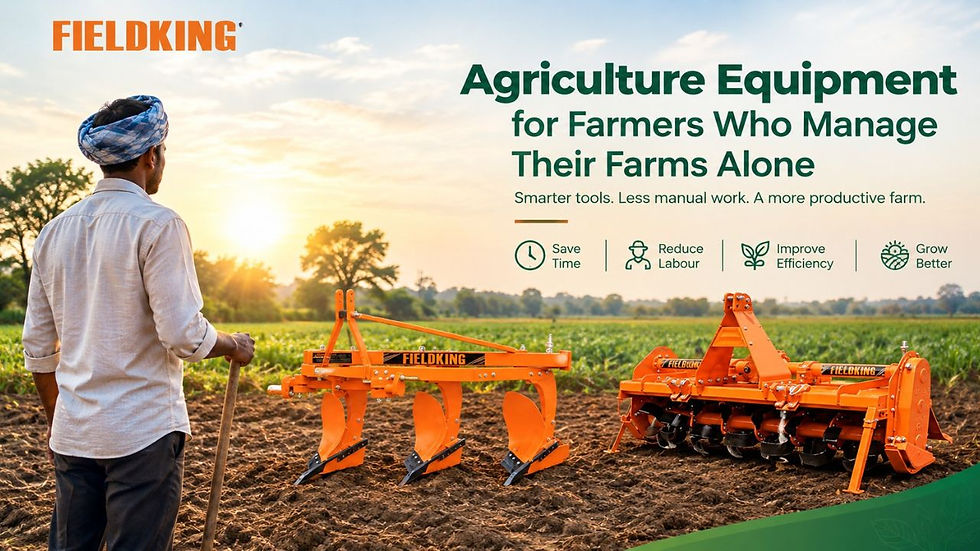
Fieldking offers advanced farming implements designed to support efficient Ploughing and better land preparation. Its equipment is developed with practical farming conditions in mind, making it suitable for Indian agriculture.
Farmers in states like Punjab, Haryana, Uttar Pradesh, Maharashtra, and Rajasthan often look for durable and fuel-efficient machinery that performs consistently during demanding seasons. Fieldking machinery is known for its strong build quality, smooth operation, and long service life.
For dealers, reliable equipment also means higher customer satisfaction and repeat demand in local agricultural markets.
Common Mistakes Farmers Should Avoid While Ploughing
Even good equipment may not deliver proper results if basic mistakes are ignored.
Ignoring Soil Condition
Ploughing extremely wet soil can damage structure and create compaction.
Using Incorrect Depth
Very deep tillage increases fuel usage without improving productivity in some crops.
Delayed Field Preparation
Late ploughing often affects sowing schedules and crop growth.
Poor Equipment Maintenance
Worn-out blades and damaged parts reduce efficiency and increase operational cost.
Future of Ploughing in Indian Agriculture
The future of farming is moving toward smarter and more efficient systems. Precision farming, GPS-guided tractors, and fuel-efficient machinery are gradually becoming part of modern agriculture.
Farmers are also adopting multi-purpose implements that save time and reduce operational expenses.
Future trends in Agricultural Machinery may include:
Smart sensor-based equipment
AI-supported farm monitoring
Low-fuel consumption machinery
Advanced soil management systems
However, the core objective remains the same — better soil preparation for healthier crops.
FAQs About Plough and Ploughing
1. What is the main purpose of a plough in farming?
A plough is used to loosen and turn the soil before sowing. It helps improve aeration, moisture retention, and weed control for better crop growth.
2. Which type of plough is best for hard soil?
Disc ploughs and moldboard ploughs are generally effective for hard and compact soil conditions because of their strong penetration ability.
3. How often should fields be ploughed?
The frequency depends on crop type, soil condition, and farming practice. Over-ploughing should be avoided to maintain soil health.
4. Why is smart ploughing important in modern agriculture?
Smart ploughing improves efficiency, saves fuel, reduces labor requirements, and supports sustainable farming practices.
5. How does Agricultural Machinery help farmers?
Modern Agricultural Machinery reduces manual work, speeds up field operations, and improves farming precision, helping farmers achieve better productivity.
Conclusion
Efficient land preparation is one of the most important steps in successful farming. The right Plough, combined with smart Ploughing techniques, can improve soil quality, increase productivity, and reduce unnecessary operational stress.
Farmers across India are increasingly adopting advanced Agricultural Machinery to improve efficiency and support sustainable farming practices. Reliable equipment and practical farming methods help create healthier fields and better crop outcomes over time.
For farmers and dealers looking to strengthen farm operations with dependable equipment, brands like Fieldking continue to support modern agriculture with solutions designed for real farming conditions.


Comments