
How Do I Choose a Plough Without Overworking My Soil?

Choosing a plough is not simply about picking the biggest implement your tractor can pull. The real question is whether the implement, working depth, soil condition, tractor power, and field requirement are working together.
Overworking the soil can happen when farmers make repeated passes without a clear purpose, work at an unsuitable depth, or choose an implement that does not match the field. This can affect soil structure, moisture management, and the timing of the next operation.
For Indian farmers, the right approach is to understand why the field needs ploughing before deciding how to plough it. This guide explains what to check when selecting a Plough while keeping unnecessary soil disturbance under control.
Start With the Condition of Your Soil
Before choosing an implement, walk through the field and look at its actual condition.
Ask yourself:
Is the soil compacted?
Is there a hard layer restricting root growth?
Is the field carrying heavy crop residue?
Is the soil too wet or too dry?
Does the previous crop require a different preparation approach?
How much soil disturbance is actually needed?
These observations can tell you more than a general recommendation.
For example, soil that is already loose and reasonably well prepared may not need repeated deep passes. On the other hand, a field with significant compaction or a specific preparation requirement may need more intensive tillage.
The goal should be adequate soil preparation, not maximum soil disturbance.
Match the Plough to the Job
Different implements perform different types of fieldwork. Farmers sometimes focus heavily on implement size while overlooking the operation they actually need to perform.
A mouldboard plough can be considered when turning and inverting the soil is part of the intended operation. A disc plough, on the other hand, may be considered for particular soil and field conditions where its design is suitable.
Neither should automatically be treated as the right choice for every farm.
Think about:
Soil type
Field condition
Required working depth
Crop rotation
Residue situation
Tractor horsepower
Field size
Number of passes required
This approach helps farmers select equipment based on purpose rather than simply following what another farmer uses.
Don't Plough Just Because the Field Is Empty
An empty-looking field does not automatically need aggressive tillage.
After harvesting, farmers may feel that another deep pass will make the field more prepared for the next crop. But if the soil already has a suitable structure and there is no specific reason for additional disturbance, another operation may not provide much practical benefit.
Before taking the tractor into the field, identify the problem you are trying to solve.
For example:
Problem: A compacted layer is restricting normal field preparation. Response: Consider whether targeted tillage is necessary.
Problem: The soil already has suitable tilth. Response: Avoid unnecessary passes.
Problem: Residue needs to be managed before sowing. Response: Choose an appropriate residue and soil-management operation rather than automatically increasing ploughing depth.
Good tillage decisions begin with observation.

Working Depth Matters More Than Many Farmers Realise
Depth should be selected according to the field requirement, not simply set as deep as the tractor and implement allow.
Deep working can require more draft and may disturb a larger volume of soil. If deep tillage is unnecessary for the crop or field condition, working deeper does not automatically mean better preparation.
Before setting the depth, consider:
The crop being planted
Existing soil structure
Rooting requirements
Compaction concerns
Soil moisture
Previous tillage
The next field operation
A farmer preparing land for wheat after paddy may have different requirements from someone preparing a field for another crop after a relatively light previous cultivation cycle.
The important question is not “How deep can I plough?”
It is “How deep does this field actually need to be worked?”
Soil Moisture Should Influence Your Decision
Soil condition at the time of tillage can have a major practical effect.
If soil is excessively wet, machinery may smear or compact parts of the working layer. If it is extremely dry, breaking the soil may require substantially more effort and may produce large clods depending on soil type and implement settings.
That does not mean there is one universal moisture level for every Indian farm. Soil texture, weather, crop, implement, and local conditions all matter.
Farmers can make better decisions by checking the field rather than relying only on the calendar.
A simple field inspection before starting the operation can help answer:
Can the soil be worked without excessive sticking?
Is it breaking in a reasonably suitable manner?
Are tractor wheels creating excessive marks?
Is the implement producing the desired soil condition?
These observations are valuable when trying to avoid unnecessary passes.
Consider Your Tractor Before Selecting Farm Equipment
A plough and tractor need to work as a matched combination.
Farmers should check the tractor's available horsepower, hitch arrangement, hydraulic capacity, operating conditions, and the implement specifications before purchase.
Using equipment that is poorly matched to the tractor can make field operations unnecessarily difficult.
When comparing farm equipment, don't look only at the implement itself. Consider the complete working combination:
Tractor + implement + soil + working depth + field size + intended operation
This gives a much more realistic picture of whether the equipment makes sense for your farm.
Farm equipment dealers can also help customers compare implements according to the tractor they already own rather than recommending equipment in isolation.
Plough vs Rotavator: Don't Treat Them as Identical
One common mistake is choosing between implements simply because both are associated with soil preparation.
A plough and a rotavator perform different types of work. The right choice depends on the condition of the field and the preparation sequence required before planting.
A farmer may need a primary tillage operation in one situation and a different approach for seedbed preparation in another.
Instead of asking:
“Which implement is better?”
Ask:
“What does my field need at this stage?”
That question produces a more useful answer.
It also reduces the temptation to use several implements simply because they are available.
Avoid Multiple Passes Without a Clear Purpose
Repeated tractor passes can become routine, especially when farmers are trying to achieve a particular appearance in the field.
But a field that looks finely worked is not necessarily a field that has been prepared in the most appropriate way.
Before every additional pass, ask:
What problem will this pass solve?
Has the previous operation already addressed it?
Will the next crop benefit from the additional disturbance?
Is the soil condition suitable for another pass?
Could the next implement perform the required task without another preliminary operation?
This simple checklist can help farmers make more deliberate tillage decisions.\
Think About the Crop Coming Next
Plough selection should not be separated from the cropping plan.
The field requirements for wheat, maize, cotton, pulses, sugarcane, or other crops can differ. The previous crop also matters.
For example, farmers managing a paddy-to-wheat rotation may have to consider residue, soil moisture, field traffic, and the time available between harvesting and sowing.
A farmer should therefore consider the entire sequence:
Previous crop → field condition → required tillage → seedbed preparation → sowing
Looking at only one operation can result in unnecessary work later.
When a Mouldboard Plough May Make Sense
A mouldboard design is associated with soil turning and inversion. Farmers considering one should first determine whether that type of operation fits their field-management objective.
Questions worth asking include:
Does the field require soil inversion?
What is the soil type?
How much residue is present?
What tractor power is available?
What working depth is required?
How many passes are planned afterward?
The answers matter more than simply choosing an implement because it is commonly used in a particular area.
When a Disc Plough May Be Worth Considering
A disc design can be considered for field conditions where its operating characteristics fit the job.
Again, the selection should be based on the actual farm rather than a blanket recommendation.
Farmers can compare:
Disc size and configuration
Working width
Working depth
Tractor compatibility
Soil conditions
Expected field capacity
Maintenance requirements
Transport considerations
For dealers, these are also useful points to discuss when helping customers narrow down their options.
What About Crop Residue?
Crop residue can complicate field preparation, particularly after crops that leave substantial material behind.
Instead of assuming that deeper ploughing is the answer, assess the type and quantity of residue first.
Consider whether the residue needs:
Incorporation
Surface management
Partial retention
Separate treatment before tillage
A different field-management approach
https://www.fieldking.com/The right solution depends on the crop, residue level, soil, local practice, and next crop.
This is another reason why choosing agricultural machinery should begin with the field problem rather than the machine catalogue.
How Fieldking Fits Into Equipment Selection
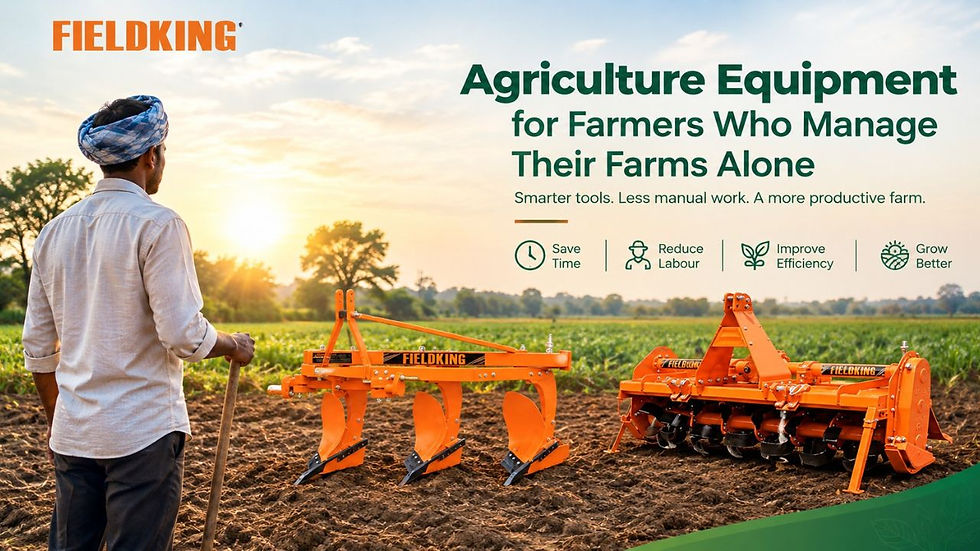
For farmers and farm equipment dealers in India, Fieldking can be considered while researching ploughs and other tractor-mounted implements. The useful starting point is not the brand name alone but the specifications and intended application of each implement. Farmers can compare available options according to tractor compatibility, soil conditions, working requirements, field size, and their planned crop cycle. This makes equipment research more practical and helps connect the implement with an actual farm operation rather than treating machinery selection as a generic purchase decision.
A Simple Plough Selection Checklist
Before buying or using a plough, run through this checklist:
1. Identify the field problem
Know why the soil needs to be worked.
2. Check soil condition
Look at moisture, texture, compaction, residue, and existing tilth.
3. Consider the next crop
The preparation requirement should fit the upcoming crop and sowing schedule.
4. Match the tractor
Check horsepower and other compatibility requirements.
5. Select the required working depth
Don't automatically choose the deepest setting.
6. Compare suitable implements
Consider whether a mouldboard, disc, or another implement fits the operation.
7. Plan the complete sequence
Avoid selecting one implement without considering what happens before and after it.
8. Reduce unnecessary passes
Every additional operation should have a clear purpose.
Common Mistakes Farmers Should Avoid
Choosing by size alone
A larger implement is not automatically more suitable for a particular farm.
Copying a neighbour's setup
Two farms in the same village can have different soil, tractors, crops, and field conditions.
Ploughing at maximum depth
Depth should be based on the requirement rather than the maximum capability of the equipment.
Ignoring moisture
The same field can behave very differently under wet and dry conditions.
Buying before checking tractor compatibility
The tractor and implement should be considered as one operating system.
Using multiple implements without a plan
More passes do not automatically mean better preparation.
FAQs About Choosing a Plough
1. How do I choose the right plough for my farm?
Start with soil type, field condition, crop rotation, required working depth, tractor horsepower, and the type of soil preparation you actually need. Then compare suitable implements against those requirements.
2. Is a deeper ploughing depth always better?
No. The required depth depends on the field condition, crop, soil, and purpose of the operation. Working deeper than necessary can create unnecessary soil disturbance and increase the workload on the tractor.
3. Should I choose a disc plough or mouldboard plough?
Neither is universally suitable for every farm. A mouldboard plough is associated with soil turning and inversion, while a disc plough has different operating characteristics. Compare the implement with your soil, crop plan, tractor, and intended operation.
4. Can the same plough be used for every crop?
Not necessarily. Crop requirements, soil conditions, residue, moisture, and the desired seedbed can change from one field or season to another. Equipment should be selected according to the actual operation required.
5. What should I check before buying a plough?
Check tractor compatibility, soil conditions, working depth, implement specifications, field size, crop requirements, maintenance considerations, and how frequently the implement will be used.
Final Thoughts
Choosing a Plough without overworking the soil comes down to making the operation purposeful. Start with the field rather than the machine. Understand the soil, identify the problem, consider the next crop, and then select equipment that matches the tractor and required operation.
For Indian farmers, this approach can be especially useful when managing tight sowing windows, changing soil conditions, crop residues, and seasonal workloads. A carefully planned tillage sequence is generally more meaningful than simply making additional passes across the field.
If you're comparing plough options, take time to review the implement specifications against your soil, tractor, crop, and actual field requirements before making the final decision.


Comments