
What Is the Best Rotavator Approach for Hard, Dry Soil?

Hard, dry soil can turn land preparation into a frustrating job. The tractor may struggle to maintain a steady pace, the implement can bounce over the surface, and repeated passes may leave the field uneven. Trying to force the machine through extremely dry ground is rarely the best approach.
A better strategy is to work with the soil rather than against it. Rotavator performance depends heavily on soil moisture, working depth, tractor power, blade condition, forward speed, and the number of passes. Getting these basics right can make soil preparation smoother and more consistent.
For Indian farmers dealing with dry conditions after harvest or before sowing, the goal should be to create a workable seedbed without unnecessarily disturbing the soil.
Why Hard, Dry Soil Is Difficult to Till
When soil loses too much moisture, it becomes harder and more resistant to mechanical penetration. Depending on soil type, the surface may develop hard clods or a compact layer.
This creates several challenges:
Greater draft requirement from the tractor
More vibration and implement bouncing
Uneven working depth
Higher stress on blades and drivetrain components
Larger soil clods after the first pass
Difficulty achieving a uniform seedbed
Clay-heavy soils can become particularly difficult when they dry into large, hard lumps. Sandy soils behave differently but can still become crusted or compacted under certain conditions.
The practical lesson is simple: soil condition should determine the tillage approach, not simply the desire to finish the field quickly.
Should You Use a Rotavator on Completely Dry Soil?
A rotavator can work in dry conditions, but extremely hard and powder-dry soil is not always the ideal situation for intensive rotary tillage.
If the soil is exceptionally hard, forcing the machine to work deep in a single pass can put unnecessary load on the tractor and implement. It can also produce inconsistent results.
A better approach is to first assess whether the soil has enough workable moisture.
Farmers can check a small section of the field before starting across the entire area. Take soil from the intended working depth and squeeze it in your hand. If it is extremely hard and will not break into manageable pieces, the field may need a different preparation strategy or better timing.
The right condition is often when the soil has enough moisture to break apart without becoming sticky.
The Best Rotavator Approach for Hard, Dry Fields
There is no single setting that works for every farm. However, the following sequence is a practical starting point.
1. Check Soil Moisture Before Entering the Field
Start by looking at the actual soil rather than relying only on the calendar.
Walk through the field and inspect:
Surface hardness
Moisture below the surface
Size of existing clods
Signs of compaction
Previous crop residue
Soil texture
If there is some moisture beneath a dry surface, working conditions may be different from a field that is dry throughout the working depth.
This small inspection can prevent unnecessary passes.
2. Avoid Taking Maximum Depth Immediately
One common mistake is trying to achieve the final working depth in the first pass.
On hard ground, a shallower initial pass can help loosen the upper layer without putting excessive load on the tractor.
After the first pass, reassess the field.
If the soil has broken sufficiently, a second operation may be used where necessary. The exact depth should depend on the crop, soil condition, implement design, and field requirements.
Deeper is not automatically better.
The objective is a suitable seedbed—not maximum soil disturbance.
3. Choose a Suitable Forward Speed
Speed has a direct effect on how the implement interacts with the soil.
If the tractor is moving too quickly through hard ground, the rotavator may struggle to maintain consistent penetration and soil mixing. If the speed is too slow under heavy conditions, unnecessary load can also develop depending on the machine and PTO setup.
Use the operating recommendations supplied for the particular implement and tractor combination.
Experienced operators generally watch the machine rather than focusing only on the speedometer. Excessive bouncing, unusual vibration, or a noticeable drop in tractor performance can indicate that conditions or settings need attention.
4. Use the Correct PTO and Tractor Setup
A rotavator relies on the tractor's PTO system to drive its rotor and blades. Incorrect PTO operation can affect performance and place unnecessary stress on components.
Before beginning work:
Confirm the implement is correctly attached.
Check the PTO shaft and safety guard.
Use the manufacturer's recommended PTO speed.
Ensure the tractor has adequate power for the implement.
Check tyre pressure and ballast according to the tractor manufacturer's guidance.
Make sure hydraulic and three-point-linkage settings are appropriate.
Farmers should avoid treating tractor horsepower as the only selection criterion. Implement width, soil type, working depth, terrain, and crop residue all influence the actual power requirement.
5. Keep Rotavator Blades in Good Condition
Blade condition becomes especially important when working tough soil.
Worn or damaged blades may not cut and mix soil as effectively as properly maintained blades. Damaged components can also create imbalance and vibration.
Before entering the field, inspect:
Blade wear
Missing or bent blades
Blade bolts and fasteners
Rotor condition
Gearbox oil level
PTO shaft
Safety guards
Replacing a worn component before a major field operation can be much easier than dealing with an unexpected breakdown during a narrow sowing window.
Hard Soil Does Not Always Mean More Passes
It can be tempting to keep making passes until the soil looks extremely fine.
That approach needs caution.
Excessive rotary tillage can break soil aggregates more aggressively than necessary and may create a very fine surface layer. Depending on soil type and weather, this can influence surface structure and erosion risk.
Instead, ask:
Does the soil already provide the conditions required for the next farming operation?
If the answer is yes, another pass may add little practical value.
Good farm equipment use is not about running machinery for as many hours as possible. It is about achieving the required field condition with an appropriate number of operations.
Rotavator vs Plough for Hard, Dry Soil
Farmers often wonder whether a rotavator or plough should be used when the field is hard.
The answer depends on the type of soil problem.
A plough is generally associated with primary soil inversion and deeper soil disturbance, while a rotavator is commonly used for secondary tillage and seedbed preparation.
For a particularly hard field, the farmer may need to first address the deeper or compacted layer using an appropriate primary tillage implement. A rotavator can then be used to refine the seedbed when conditions are suitable.
A practical comparison
Field condition | Possible approach |
Lightly dry surface | Rotavator may be suitable |
Hard upper layer | Consider shallow initial tillage |
Deep compaction | Evaluate suitable primary tillage |
Large soil clods | Gradual soil preparation |
Adequate moisture | Rotary tillage may perform better |
Very dry, hard soil | Avoid forcing excessive depth |
The correct choice should always be based on the actual soil condition and crop requirement.
How Soil Type Changes the Rotavator Strategy
Not all hard soils behave the same way.
Clay Soil
Clay can become extremely hard when dry and sticky when overly wet. Working it at the wrong moisture level can result in poor clod breakdown or excessive smearing.
Farmers should aim for a workable condition where the soil breaks rather than deforms.
Loamy Soil
Loam generally offers a wider workable range, but dry conditions can still create hard patches. A controlled pass at an appropriate depth can help prepare the field without unnecessary disturbance.
Sandy Soil
Sandy soil usually requires a different approach because it does not behave like heavy clay. Excessive tillage may not provide additional benefits and can leave the surface vulnerable to wind erosion in some conditions.
This is why agricultural machinery should be operated according to field conditions rather than using one universal setting.
What Farmers Should Watch During Operation
You can learn a lot by observing the machine while it is working.
Stop and inspect the field if you notice:
The implement repeatedly bouncing
Uneven working depth
Excessive vibration
Large unbroken clods
Tractor engine struggling unusually
Excessive blade or component noise
Significant variation between passes
The appearance of the field behind the machine is also useful. Soil should be prepared according to the intended crop and subsequent operation—not simply made as fine as possible.
A Practical Example for Indian Farms
Consider a farmer preparing a field after a dry period.
The topsoil looks hard, but there is some moisture below the surface. Instead of immediately setting the rotavator for maximum depth, the farmer checks a small section first.
The initial operation is kept controlled. Afterward, the farmer checks soil breakup, working depth, tractor response, and remaining clods.
If the field condition is acceptable, there is no need to keep disturbing it simply to create a finer appearance.
This approach can be particularly useful where farmers have limited time between harvesting one crop and sowing the next.
Choosing the Right Rotavator for Your Farm
Selecting a machine should start with the farm rather than the catalogue.
Consider:
Tractor horsepower – Match the implement to the tractor's recommended operating range.
Working width – Choose a width appropriate for field size and tractor capability.
Soil type – Heavy soils can demand different specifications than lighter soils.
Crop residue – Consider the amount and type of residue expected.
Working depth – Determine the depth required for your cropping system.
Service support – Availability of maintenance and replacement parts matters during the season.
Frequency of use – Annual workload should influence your equipment decision.

For farm equipment dealers, these are also useful questions to ask customers before recommending a particular implement.
Why Timing Can Matter More Than Machine Power
A powerful tractor cannot completely compensate for poor soil conditions.
If the soil is extremely dry, even a capable tractor and properly selected rotavator may face difficult operating conditions. Waiting for suitable moisture, where farming schedules and weather allow it, can sometimes make a larger difference than increasing machine size.
This is particularly relevant in Indian agriculture, where soil and weather conditions can vary considerably between regions.
The best machinery decision is therefore a combination of equipment selection, field timing, operator skill, and soil awareness.
Local Perspective: Using Rotavators in India
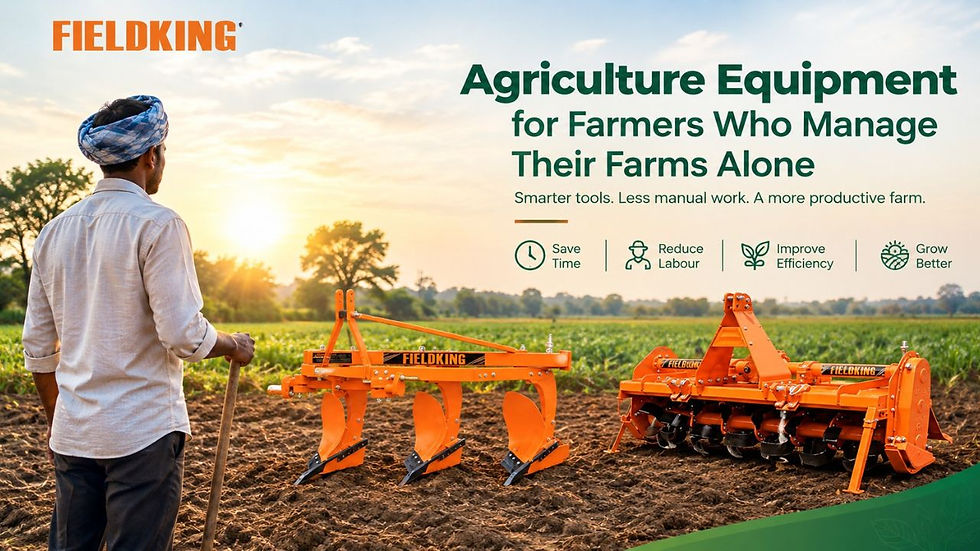
Across India's diverse farming regions, soil texture, crop cycles, irrigation availability, and field conditions vary widely. Farmers may encounter hard dry soils after wheat, rice, cotton, pulses, or other crops, but the appropriate tillage method can differ from one situation to another. Fieldking develops agricultural implements for different farm applications, giving Indian farmers and farm equipment dealers options to evaluate based on tractor compatibility, soil conditions, crop requirements, and the type of field preparation needed.
FAQs About Rotavator Use in Hard, Dry Soil
1. Can a rotavator work effectively in hard, dry soil?
It can, depending on soil condition, machine configuration, tractor capacity, and working depth. Extremely hard soil may require a different or staged tillage approach rather than forcing the rotavator deep in one pass.
2. Should I use maximum depth on hard soil?
Usually, maximum depth should not be the starting point simply because the soil is hard. Begin according to the required field condition and machine recommendations, then assess whether additional depth is actually necessary.
3. Is a rotavator better than a plough for hard soil?
Neither is universally better. A plough and rotavator perform different tillage functions. The right choice depends on whether the field needs primary soil disturbance, clod management, seedbed preparation, or another specific operation.
4. How do I know if my soil has suitable moisture for rotary tillage?
Inspect soil below the surface and test how it breaks when handled. Soil that is extremely hard may be difficult to work efficiently, while excessively wet soil can smear or stick. The ideal condition varies with soil type and the intended operation.
5. What should I check before using a rotavator?
Check the blades, fasteners, PTO shaft, guards, gearbox, attachment, tractor compatibility, and operating settings. Also inspect the field for stones, obstacles, excessive residue, and unsuitable soil conditions.
Final Takeaway
The best rotavator approach for hard, dry soil is not simply to increase depth or tractor power. Start by understanding the soil, select the appropriate implement, work at a sensible depth, follow recommended PTO and operating settings, and reassess the field after each operation.
For farmers, the most useful rule is straightforward: prepare the soil enough for the next crop operation, but avoid unnecessary disturbance.
If you're evaluating Fieldking equipment for a particular tractor, crop, or soil condition, compare the machine's specifications with your actual field requirements and operating conditions before making a decision.


Comments