
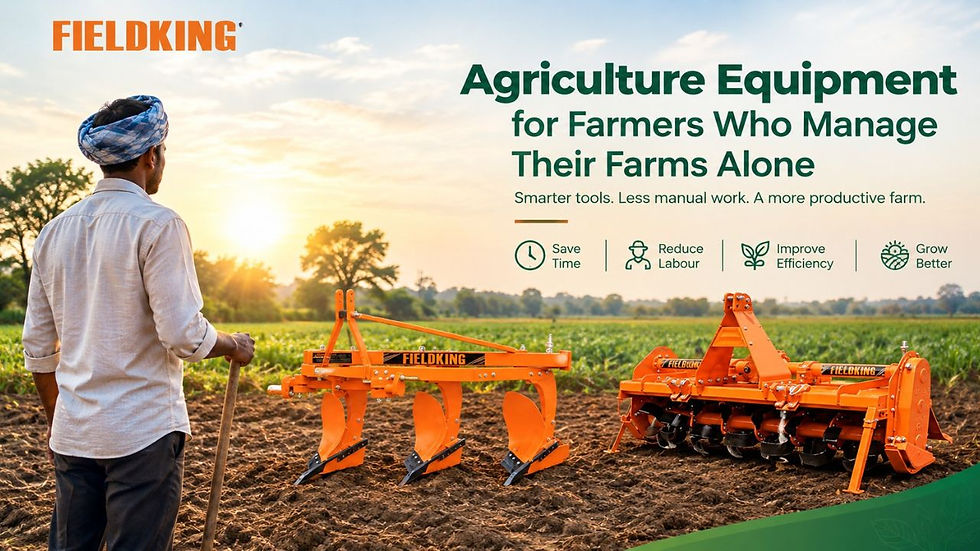
Agriculture Equipment for Farmers Who Manage Their Farms Alone

Managing a farm alone is not easy. One person may have to handle field preparation, sowing, weed control, crop maintenance, harvesting, and even moving produce from one place to another. When labour is limited, the right agriculture equipment can make these jobs much more manageable.
For a farmer working independently, machinery is not simply about replacing manual labour. It is about choosing equipment that can handle several important jobs without creating unnecessary operating complexity. The right combination of farm equipment can help a farmer complete field operations on time, maintain consistency, and spend more time monitoring the crop instead of doing every task manually.
For Indian farmers, equipment selection also needs to match soil conditions, crop type, tractor capacity, farm size, and the availability of local service support.
Why Farmers Managing Alone Need the Right Equipment
A farmer working without a regular labour team has one major limitation: time.
A field may be ready for cultivation, but waiting several days for labour can affect the next operation. Similarly, harvesting cannot always be delayed simply because enough workers are unavailable.
This is where agricultural machinery becomes useful.
The goal is not to purchase every machine available. Instead, farmers should identify the operations that consume the most labour or regularly cause delays.
For example, a farmer may find that:
Land preparation takes too much manual effort.
Sowing becomes difficult when labour is unavailable.
Weed management requires repeated field visits.
Harvesting creates a major labour requirement.
Crop residues are difficult to manage after harvest.
Transporting farm materials takes considerable time.
Equipment selected around these problems can provide much greater value than machinery purchased simply because it is popular.
Start With the Jobs That Take the Most Time
Before purchasing agriculture equipment, make a simple list of your regular farming activities.
Ask yourself:
Which operation requires the most labour?
Which task is most likely to be delayed?
Which job needs to be repeated several times during a season?
Which operation affects the next stage of crop production?
Can one implement be used for more than one crop or field condition?
This approach makes machinery selection more practical.
For instance, if soil preparation is a recurring challenge, investing in suitable tillage equipment may make more sense than buying machinery for a task performed only once a year.
Essential Agriculture Equipment for Independent Farmers
The exact machinery requirement depends on the farm, but some categories can significantly reduce dependence on manual work.
1. Rotavator for Field Preparation
A rotavator can be useful when a farmer needs to prepare the seedbed efficiently after previous crop operations.
It works by breaking and mixing soil with rotating blades, helping create a workable soil surface for planting.
For a farmer managing alone, the main advantage is operational convenience. Instead of relying heavily on manual soil preparation, the tractor-mounted implement can cover the field systematically.
However, working depth and operating conditions should be selected according to the soil and crop requirement. Excessive passes are not automatically better.
2. Plough for Primary Tillage
A plough is useful when deeper soil disturbance or primary tillage is required.
Different plough designs are suited to different field conditions. A farmer should therefore consider soil type, moisture, crop rotation, and tractor capacity before choosing one.
For independent farmers, having the appropriate primary tillage implement can reduce the amount of repeated manual field preparation.
3. Cultivator for Routine Soil Preparation
A cultivator can be useful for farmers who regularly need to loosen soil, prepare fields, or perform secondary tillage.
Compared with doing these jobs manually, tractor-operated equipment can cover larger areas more consistently.
The key is matching the implement with the tractor rather than choosing equipment based only on its size.
4. Seed Drill for More Consistent Sowing
Sowing is one of those operations where timing and consistency matter.
A seed drill can help place seeds at more uniform spacing and depth while reducing the amount of manual effort involved in planting.
For a farmer working alone, this can be particularly helpful because sowing a larger field manually can require considerable time and labour.
The right seed drill should be selected according to crop, seed characteristics, row spacing, soil conditions, and tractor compatibility.
5. Sprayer for Crop Protection
Crop protection often requires timely application. Waiting for sufficient labour may not be practical when a crop needs attention.
A suitable sprayer can help farmers cover fields more systematically and reduce the physical effort involved in manual spraying.
Farmers should pay attention to application requirements, boom width, tank capacity, nozzle selection, and safe handling rather than focusing only on machine capacity.
6. Harvester for Labour-Intensive Harvesting
Harvesting can become one of the biggest challenges for farmers working alone.
Depending on the crop, harvesting machinery can reduce dependence on large seasonal labour teams and help complete the operation within the required crop window.
For crops such as wheat, rice, and other grains, combine harvesting equipment can perform multiple harvesting-related operations in a single field operation.
The suitability of the machine depends heavily on crop conditions, field size, terrain, and local harvesting requirements.
Choose Equipment According to Your Tractor
One of the most common mistakes farmers make is selecting an implement first and checking tractor compatibility later.
The tractor is the power source for many categories of farm equipment, so its horsepower, hydraulic capacity, lifting ability, PTO requirements, and overall configuration need to be considered.
Before purchasing an implement, check:
Tractor horsepower requirement
PTO specifications
Hydraulic lifting capacity
Implement working width
Field size
Soil condition
Transport requirements
Availability of replacement parts
Local service support
A larger implement is not automatically a better implement.
For a farmer working independently, equipment that is easy to operate, maintain, attach, and transport can sometimes be more useful than a larger machine with features that are rarely needed.
Multi-Crop Equipment Can Be a Practical Choice
Farmers growing several crops often need to think differently about machinery.
Buying separate equipment for every crop can increase investment and maintenance requirements. Multi-purpose or broadly compatible agricultural machinery may therefore provide better utilization.
For example, a farmer growing different crops throughout the year can prioritize implements that fit several stages of field preparation or crop production.
This is particularly relevant for Indian farms where cropping patterns can change according to season, irrigation availability, market conditions, and local climate.
The best machine is often the one that spends more time working rather than sitting unused.
Consider Farm Size Before Buying Machinery
Farm size has a direct impact on whether purchasing, hiring, or custom hiring equipment makes sense.
A small farmer may not need to own every piece of agricultural machinery. Some specialized operations may be more economical to outsource or hire locally.
On the other hand, if a particular operation is performed repeatedly and labour availability is consistently difficult, owning the appropriate equipment can make more sense over several seasons.
A useful way to evaluate equipment is to consider:
Frequency of use + labour saved + area covered + expected working life + maintenance requirements
This gives a more realistic picture than looking at the purchase cost alone.
Agriculture Equipment Should Reduce Complexity, Not Add to It
For farmers working alone, machinery management itself can become a burden.
An implement that requires frequent adjustments, difficult maintenance, or specialized servicing may create problems during peak farming periods.
Before buying, ask:
Can I operate it comfortably?
Can I attach it to my tractor without unnecessary difficulty?
Are spare parts available nearby?
Is routine maintenance straightforward?
Can local mechanics service it?
Will I use it often enough to justify ownership?
These questions are particularly valuable when purchasing equipment for the first time.
Fieldking Agriculture Equipment for Indian Farming Conditions
For farmers in India, Fieldking offers a broad range of agricultural implements covering different farming operations, including tillage, seeding, crop protection, harvesting, and other field applications.
When evaluating equipment, farmers can compare the implement's working requirements with their tractor, crop type, soil condition, and farm size. This practical approach helps avoid buying machinery that does not fit the actual operation.
The focus should always remain on finding equipment that makes the farmer's existing workflow easier and more manageable.
How Farmers Can Build Their Equipment Setup Gradually
A farmer does not need to mechanize the entire farm in one purchase.
A gradual approach can be more practical.
Step 1: Identify the biggest labour problem
Find the operation that causes the most delay or requires the most physical work.
Step 2: Mechanize that operation first
Choose equipment specifically designed for that task and compatible with your tractor.
Step 3: Measure the results
After a season, compare the time, labour requirement, field coverage, and maintenance involved.
Step 4: Add the next useful implement
Once the first equipment has proven useful, consider the next operation that creates a bottleneck.
This approach allows farmers to build a useful machinery setup without unnecessarily increasing their equipment costs.
Agriculture Equipment vs Manual Farming: What Should You Choose?
Manual farming still has its place, particularly for small, specialized, or difficult-to-access areas. But relying entirely on manual work can become challenging when labour is scarce or operations need to be completed quickly.
Agriculture equipment becomes especially useful when:
The farm area is difficult to manage manually.
Labour availability is unpredictable.
Several operations must be completed within short time windows.
The farmer wants more consistent field operations.
Physical workload has become difficult to sustain.
The practical answer is often not completely manual or completely mechanized farming. A balanced approach usually works better.
Use machinery where it provides a clear advantage, while retaining manual methods for tasks where they remain efficient.
Common Mistakes to Avoid When Buying Farm Equipment
Farmers managing their operations alone should avoid purchasing equipment based purely on advertisements or machine size.
Some common mistakes include:
Choosing an implement without checking tractor compatibility.
Buying machinery that is rarely used.
Ignoring local soil conditions.
Overlooking maintenance requirements.
Focusing only on initial purchase cost.
Not checking spare-part availability.
Selecting equipment that is unnecessarily complicated to operate.
Forgetting about storage and transportation requirements.
A machine should solve a farming problem, not create another one.
FAQs About Agriculture Equipment for Independent Farmers
What agriculture equipment should a farmer buy first?
Start with equipment for the farming operation that consumes the most labour or regularly causes delays. For many farmers, this may be tillage, sowing, spraying, or harvesting. The right choice depends on crop, farm size, tractor capacity, and local conditions.
Which farm equipment is suitable for small farmers?
Small farmers should prioritize versatile equipment that can be used regularly across different crops or field operations. Tractor-compatible implements such as cultivators, rotavators, seed drills, and suitable ploughs can be considered depending on individual requirements.
How do I choose agricultural machinery for my tractor?
Check the implement's recommended horsepower, PTO requirements, hydraulic requirements, working width, and weight against your tractor's specifications. Always consider the actual field conditions and intended application as well.
Is buying agriculture equipment better than hiring it?
It depends on usage. Equipment used frequently over several seasons may justify ownership, while specialized machinery used only occasionally may be more economical to hire. Farmers should compare utilization, maintenance, hiring charges, and expected working life.
Can one farmer operate modern agricultural machinery alone?
Many tractor-mounted implements are designed for operation by a tractor driver, but the exact workload depends on the machine and farm operation. Ease of attachment, adjustment, operation, and maintenance should be considered when choosing equipment for independent farming.
Final Thoughts
Managing a farm alone does not mean every farming task has to be done manually. The right agriculture equipment can help an independent farmer handle demanding operations more efficiently while reducing dependence on seasonal labour.
The smartest approach is to start with the biggest bottleneck. Understand your farm size, crop pattern, soil, tractor capacity, and working conditions before selecting machinery.
For Indian farmers, Fieldking can be explored as one option when comparing agricultural implements for different field operations. Rather than buying equipment simply because it is available, choose machinery based on the jobs you actually need to complete.
A well-planned equipment setup does not have to be large. It simply needs to work for your farm.


Comments