
Can Agricultural Machinery Improve Residue Management and Protect Soil Structure?

Crop residue is often treated as a problem that needs to be cleared before the next crop. But stalks, straw, leaves, and roots left after harvest can also play a useful role in the field. They can add organic matter, reduce the impact of rain and wind on exposed soil, and contribute to better moisture management when handled properly.
The challenge for farmers is finding the right balance between residue management and soil preparation.
This is where modern agricultural machinery can make a practical difference. The right implement can help cut, spread, incorporate, or manage residue while preparing the field for the next crop. However, machinery alone does not guarantee better soil health. The result depends on equipment selection, working depth, soil moisture, residue quantity, tractor settings, and the number of passes made across the field.
For Indian farmers, where soil types, cropping patterns, and residue conditions vary widely, machinery decisions need to be based on the actual field rather than a one-size-fits-all approach.

Why Crop Residue Matters for Soil Health
After harvesting, a field can contain considerable amounts of plant material. Wheat straw, paddy residue, maize stalks, cotton stalks, and other crop remains behave differently once they are on the soil surface.
Leaving suitable residue in the field can provide several benefits:
Protecting the soil surface from direct rainfall impact
Reducing wind erosion
Supporting organic matter levels
Helping conserve moisture under suitable conditions
Providing a source of carbon as residue decomposes
Supporting biological activity in the soil
The challenge comes when residue is unevenly distributed or present in quantities that interfere with the following operation.
For example, a thick layer of straw can make seed placement difficult. Large stalks may interfere with tillage equipment. Poorly distributed residue can also create areas with different moisture and soil conditions.
Good residue management aims to use the residue as a resource while maintaining a workable seedbed.
How Agricultural Machinery Supports Residue Management
Different implements perform different jobs. Some cut and mix residue, while others loosen soil or prepare the final seedbed.
Choosing the correct machine can reduce the need for repeated operations.
A suitable implement may help farmers:
Chop or break down crop residue
Mix appropriate residue into the soil
Prepare the seedbed
Reduce manual residue handling
Improve field uniformity
Complete several preparation tasks in fewer passes
This is particularly useful when the time between harvest and sowing is short.
The objective should not be to bury every piece of residue. Instead, the machinery should create field conditions that support the next crop while maintaining reasonable soil structure.
Can Machinery Protect Soil Structure?
Yes, but only when it is used correctly.
Soil structure refers to how individual soil particles are arranged into aggregates. Good aggregation creates pores that allow air, water, and roots to move through the soil.
Repeated or poorly timed tillage can disturb these aggregates. Heavy machinery operated when soil is too wet can also increase compaction, especially in wheel tracks.
This means the question is not simply whether a machine is good or bad for soil.
The more useful questions are:
How deep is the implement working?
How many passes are being made?
Is the soil at a workable moisture level?
Is the machine correctly matched with the tractor?
How much residue is present?
What does the next crop require?
These factors often determine the actual effect on soil structure.
Fewer Field Passes Can Make a Difference
Every trip across the field adds traffic.
If one implement can complete a required operation effectively, making additional passes simply to achieve an extremely fine soil surface may not provide much value.
Reducing unnecessary passes can help:
Reduce soil traffic
Fewer tractor movements mean less repeated pressure on the same areas of the field.
Save preparation time
A farmer can move from harvest residue management to sowing preparation more quickly.
Reduce machinery workload
Fewer operating hours can reduce wear on tractor and implement components.
Maintain better field timing
Timely sowing is especially important when the following crop has a defined planting window.
This is why reduced-pass farming is increasingly being considered alongside soil-health goals.
The Role of a Rotavator in Residue Management
A rotavator is one example of machinery that can combine several soil-preparation functions.
Its rotating blades cut and mix soil while working through suitable surface residue. Depending on the field condition and residue quantity, this can help incorporate plant material and prepare the upper soil layer for sowing.
However, a rotavator should not automatically be used multiple times.
A practical approach is to assess the field after the first operation.
Check:
Whether residue has been distributed adequately
Whether large clods remain
Whether the desired working depth has been reached
Whether the soil is excessively pulverised
Whether the seedbed is suitable for the following crop
If the required condition has already been achieved, another pass may not add meaningful value.
Residue Management Is Not the Same as Residue Removal
One common misconception is that a clean-looking field is automatically healthier.
A field with every piece of residue removed may look neat, but removing organic material continuously can reduce the amount of plant-derived material returned to the soil.
The better objective is controlled residue management.
Depending on the farming system, this may involve:
Keeping some residue on the surface
Chopping larger material
Spreading residue evenly
Incorporating suitable quantities
Combining residue management with other conservation practices
The right choice depends heavily on crop rotation, rainfall, irrigation, soil type, and the next crop.
Soil Moisture: The Factor Farmers Should Not Ignore
Even good agricultural machinery can produce poor results when used under unsuitable soil conditions.
Working soil when it is too wet can cause smearing and compaction. On the other hand, extremely dry and hard soil can increase draft requirements and make residue incorporation or soil preparation more difficult.
Farmers should observe how the soil behaves during operation.
Useful field observations include:
Whether soil sticks heavily to components
Whether tractor wheels leave deep ruts
Whether the soil breaks into workable aggregates
Whether the machine requires unusually high power
Whether the surface becomes excessively powdery
Local experience matters here. A farmer familiar with a particular field often knows its workable moisture range better than a generic recommendation can describe.
Choosing the Right Agricultural Machinery
There is no single implement that is ideal for every residue-management situation.
Before selecting equipment, farmers and dealers should consider:
1. Crop residue
Paddy straw, wheat straw, maize stalks, and other residues differ in thickness, quantity, and decomposition behaviour.
2. Soil type
Clay, loam, sandy, and mixed soils respond differently to tillage.
3. Farm size
A small farm may have different machinery requirements from a large commercial operation.
4. Tractor capacity
The implement should be compatible with the tractor's available power and operating capability.
5. Desired working depth
Deep disturbance is not always necessary for seedbed preparation.
6. Number of field operations
Consider whether the chosen equipment can consolidate tasks without creating excessive soil disturbance.
7. Maintenance and service
Wear parts, blades, bearings, adjustment mechanisms, and service availability should be considered before purchase.
For equipment dealers, these points can help create more useful conversations with farmers. Instead of recommending equipment based only on width or capacity, the discussion can begin with the customer's actual soil and residue conditions.
Agricultural Machinery and Sustainable Farming in India
Indian agriculture includes a wide range of farming environments, from irrigated cereal systems in northern states to diverse cropping systems across central and southern regions. Residue-management challenges therefore differ considerably.
In India, farmers considering agricultural machinery for residue management should assess local soil conditions, crop rotation, residue levels, rainfall or irrigation patterns, and the time available between harvest and the next sowing.
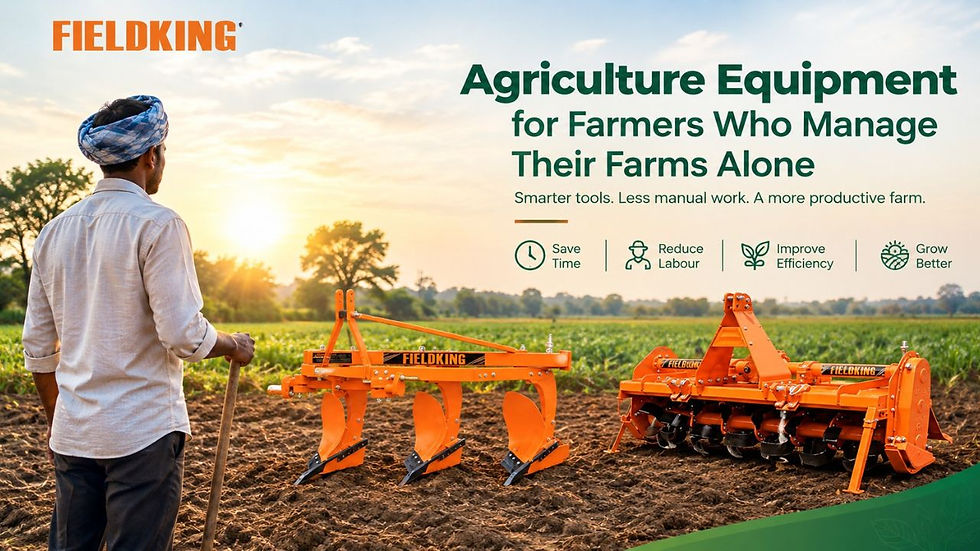
Fieldking offers a range of agricultural implements designed for different farm operations. For farmers and farm equipment dealers, the most useful starting point is to match the implement with the field requirement rather than choosing equipment based solely on general specifications.
A Practical Example: Two Different Fields
Imagine a farmer has two fields after harvest.
Field A has moderate residue distributed fairly evenly. The soil has suitable moisture and relatively few compacted areas. A properly selected implement may be able to manage residue and prepare the upper soil layer in one operation.
Field B has heavy residue concentrated in rows, compacted wheel tracks, and uneven moisture. Using the same approach may not provide the same result.
The second field may require a different sequence or additional residue-management step.
This example highlights an important principle: machinery should follow field conditions, not the other way around.
How to Reduce Unnecessary Soil Disturbance
Farmers looking to combine productivity with soil care can follow a few practical principles:
Avoid unnecessary repeat tillage.
Operate machinery when soil moisture is suitable.
Match implement size with tractor capacity.
Keep residue distribution as uniform as practical.
Select working depth according to the crop and soil requirement.
Inspect the field after each major operation.
Avoid creating an unnecessarily fine seedbed.
Consider the complete crop rotation rather than one season alone.
These practices can help machinery become part of a broader soil-management strategy rather than simply a means of completing fieldwork faster.
Frequently Asked Questions
1. Can agricultural machinery improve crop residue management?
Yes. Suitable machinery can chop, mix, spread, or incorporate residue and can also help prepare the soil for the following crop. The correct approach depends on residue type, quantity, soil condition, and crop requirements.
2. Does residue incorporation improve soil health?
Residue can contribute organic material to the soil as it decomposes. However, the result depends on residue type, soil conditions, moisture, decomposition, and the broader crop-management system. Incorporation should not be treated as automatically better than retaining some residue on the surface.
3. Can fewer machinery passes protect soil structure?
Reducing unnecessary passes can reduce traffic and repeated soil disturbance. However, fewer passes alone do not guarantee better soil structure. Appropriate moisture, working depth, equipment selection, and overall tillage strategy also matter.
4. Is a rotavator suitable for residue management?
A rotavator can manage and incorporate suitable surface residues while preparing the soil. Its suitability depends on residue quantity, soil condition, tractor compatibility, working depth, and the requirements of the following crop.
5. How should farmers choose machinery for residue management?
Start with the field. Consider soil type, residue quantity, crop rotation, farm size, tractor capacity, desired working depth, and the number of operations required. Then compare implements that can perform the required work without unnecessary soil disturbance.
Final Takeaway
Agricultural machinery can improve residue management while supporting soil structure—but the machine is only one part of the equation.
Good results come from matching equipment to field conditions and using it at the right time, depth, and operating setting.
The strongest approach is not simply to remove or bury residue as quickly as possible. It is to manage crop remains in a way that supports the next crop while avoiding unnecessary soil disturbance and repeated field traffic.
For Indian farmers, this means looking beyond machine specifications and considering the complete field-preparation system. The right implement, sensible operating practices, and fewer unnecessary passes can work together to make residue management more practical and soil-friendly.
Farmers and farm equipment dealers can explore Fieldking's agricultural machinery range with these factors in mind and compare equipment according to their specific soil, residue, tractor, and cropping requirements.


Comments