
Breaking Ground: The Story Behind Plough and Its Role in Modern Farming

Introduction: Why the Plough Still Matters Today
Did you know that the plough is one of the oldest agricultural tools ever invented—and yet, it remains just as relevant today? From ancient wooden designs to modern steel-built implements, the journey of farming truly began when humans started breaking soil intentionally. Breaking Ground: The Story Behind Plough highlights how this simple yet powerful tool transformed agriculture and continues to support farmers worldwide.
A plough is not just about turning soil; it plays a vital role in improving aeration, controlling weeds, and preparing land for healthy crops. In today’s era of mechanized farming, brands like Fieldking have taken this traditional tool and enhanced it with modern engineering, durability, and performance. This article explores the evolution, types, benefits, and real-world importance of ploughs in modern agriculture.
The Origin of the Plough – Where Farming Began
Long before tractors and machines, early farmers used primitive ploughs made of wood and stone.
A Brief Historical Timeline
3000 BCE: Wooden ploughs used in Mesopotamia
Medieval Era: Iron-tipped ploughs improve soil penetration
Industrial Age: Steel ploughs revolutionize large-scale farming
Modern Farming: Tractor-mounted ploughs by leaders like Fieldking
The plough enabled farmers to cultivate larger areas efficiently, laying the foundation for food security and civilization growth.

What Is a Plough and How Does It Work?
A plough is an agricultural implement used to loosen, turn, and break soil before sowing crops.
Key Functions of a Plough
Turns soil to improve aeration
Buries weeds and crop residue
Enhances nutrient availability
Prepares a uniform seedbed
Fieldking ploughs are designed to perform all these tasks efficiently, even in hard and dry soil conditions.
Types of Ploughs Used in Modern Agriculture
Different farming needs require different plough designs. Fieldking offers a wide range to suit Indian soil types.
Common Types of Ploughs
Mould Board Plough: Ideal for complete soil inversion
Disc Plough: Suitable for hard and trash-filled soils
Reversible Plough: Saves time with bidirectional operation
Mounted Plough: Easy to attach and operate with tractors
Each type is engineered to maximize productivity while minimizing fuel consumption.
Why Ploughing Is Essential for Healthy Crops
Skipping proper ploughing can directly affect crop yield.
Benefits of Using a Quality Plough
Better root penetration
Improved water absorption
Reduced pest and weed growth
Uniform crop emergence
Fieldking ploughs ensure consistent depth and smooth operation, helping farmers achieve reliable results season after season.
Fieldking’s Innovation in Plough Technology
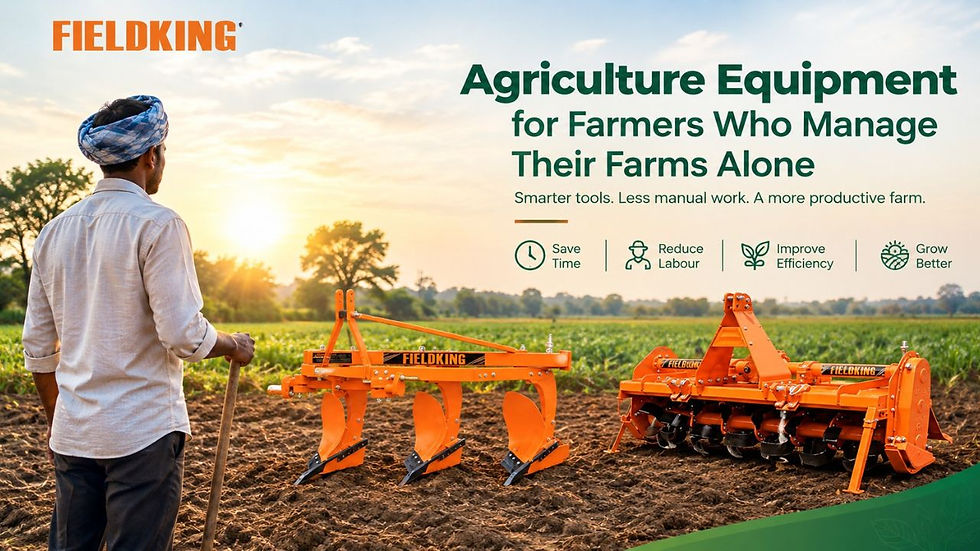
Fieldking has modernized the traditional plough by combining strength with precision.
What Makes Fieldking Ploughs Stand Out?
High-grade steel construction
Precision-engineered blades
Compatibility with multiple tractor HP ranges
Low maintenance and long service life
These features make Fieldking a trusted name among farmers seeking durability and performance.
Step-by-Step Guide to Choosing the Right Plough
Choosing the right plough depends on several factors.
Simple Selection Checklist
Identify your soil type (hard, soft, dry, wet)
Match plough type with crop requirement
Check tractor horsepower compatibility
Evaluate field size and terrain
Choose a reliable brand like Fieldking
This approach ensures better efficiency and long-term value.
Plough vs Other Tillage Implements
While tools like cultivators and rotavators are popular, ploughs remain essential.
Key Differences
Ploughs provide deeper soil inversion
Rotavators focus on fine tilth
Cultivators are ideal for shallow tillage
Many farmers use Fieldking ploughs as the first step, followed by secondary tillage implements.
FAQs About Ploughs
What is the main purpose of a plough?
A plough is used to break and turn soil, improving aeration and preparing land for sowing.
Which plough is best for hard soil?
Disc ploughs from Fieldking are highly effective in hard and dry soil conditions.
How often should ploughing be done?
Typically before every cropping season, depending on soil condition and crop type.
Can ploughs be used with modern tractors?
Yes, Fieldking ploughs are designed to be tractor-compatible and easy to operate.
Conclusion: Why the Plough Will Never Lose Its Importance
From ancient farmlands to today’s mechanized agriculture, the plough has remained the backbone of cultivation. Breaking Ground: The Story Behind Plough shows that while farming tools evolve, their purpose stays the same—better soil, better crops, and better livelihoods. With innovation-driven brands like Fieldking, farmers can rely on modern ploughs that deliver strength, efficiency, and long-term value.


Comments